Anatomy of a Conceptual Image

To my mind, there are two kinds of composite images.

The first is the kind that’s shot all at once in a single location. You’re getting different pieces of the image across multiple photos, but the lighting isn’t changing and your camera is stationary. You choose which photos you want to comprise your final image, and in Photoshop you layer them and mask in all the individual elements. This is pretty straightforward.
The second kind of composite image is the one that’s shot in different locations at different times. At least one location is a “real” place, the other is often the studio. This type of composite image is more fun because it’s harder from both a conceptual and technical standpoint, and planning the pieces and how they’ll fit together is very much like a puzzle. Lighting, camera position, and focal length all need to match, and this often takes some imagination at one stage of the shoot or another.

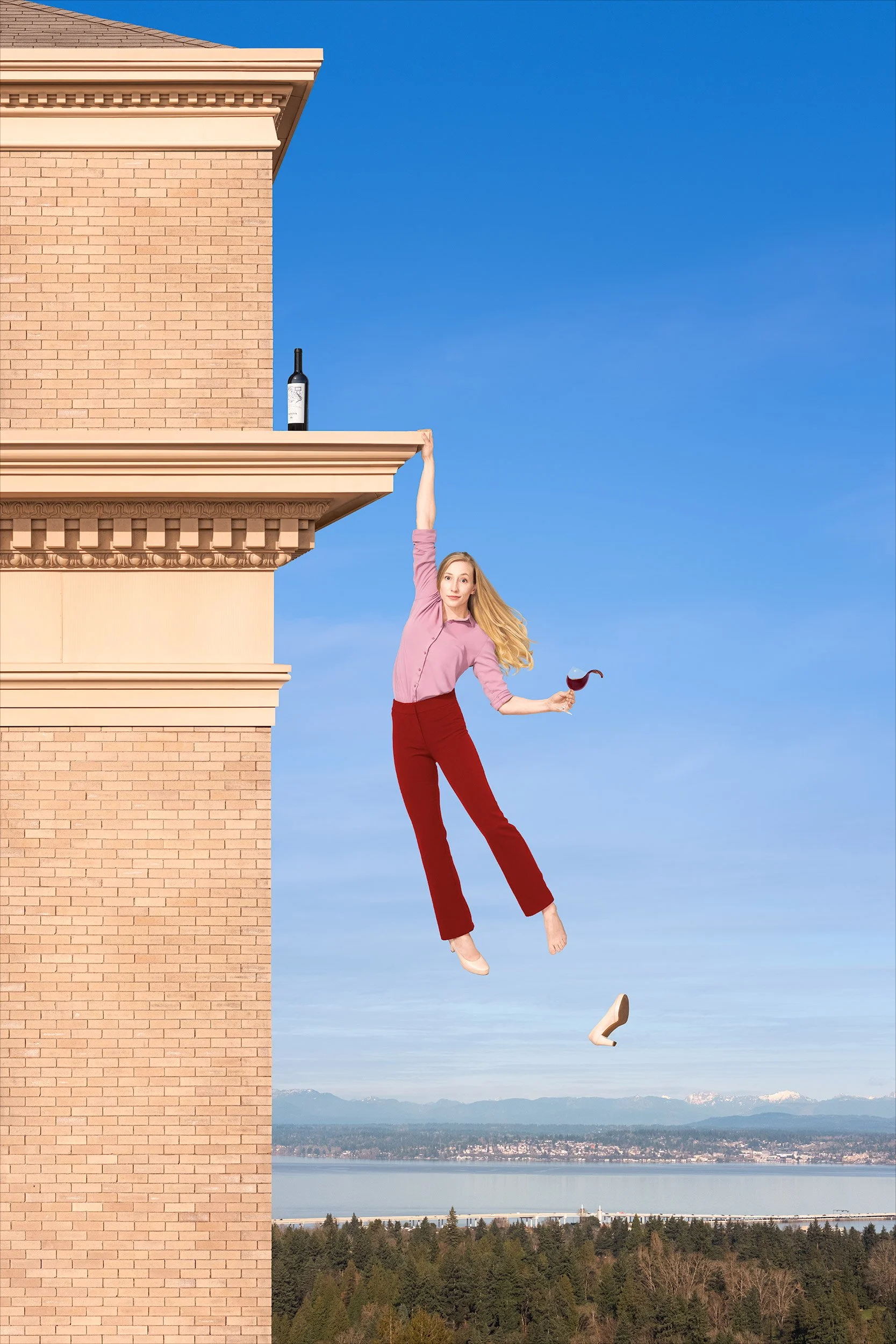
The image below is the second sort of composite, and below I’ll talk about the shoot and the edit, as well as my practical and creative considerations along the way.

The image is made up of twenty-two individual pictures. More than you’d expect, right? You’re welcome to try to guess them, but here they are:

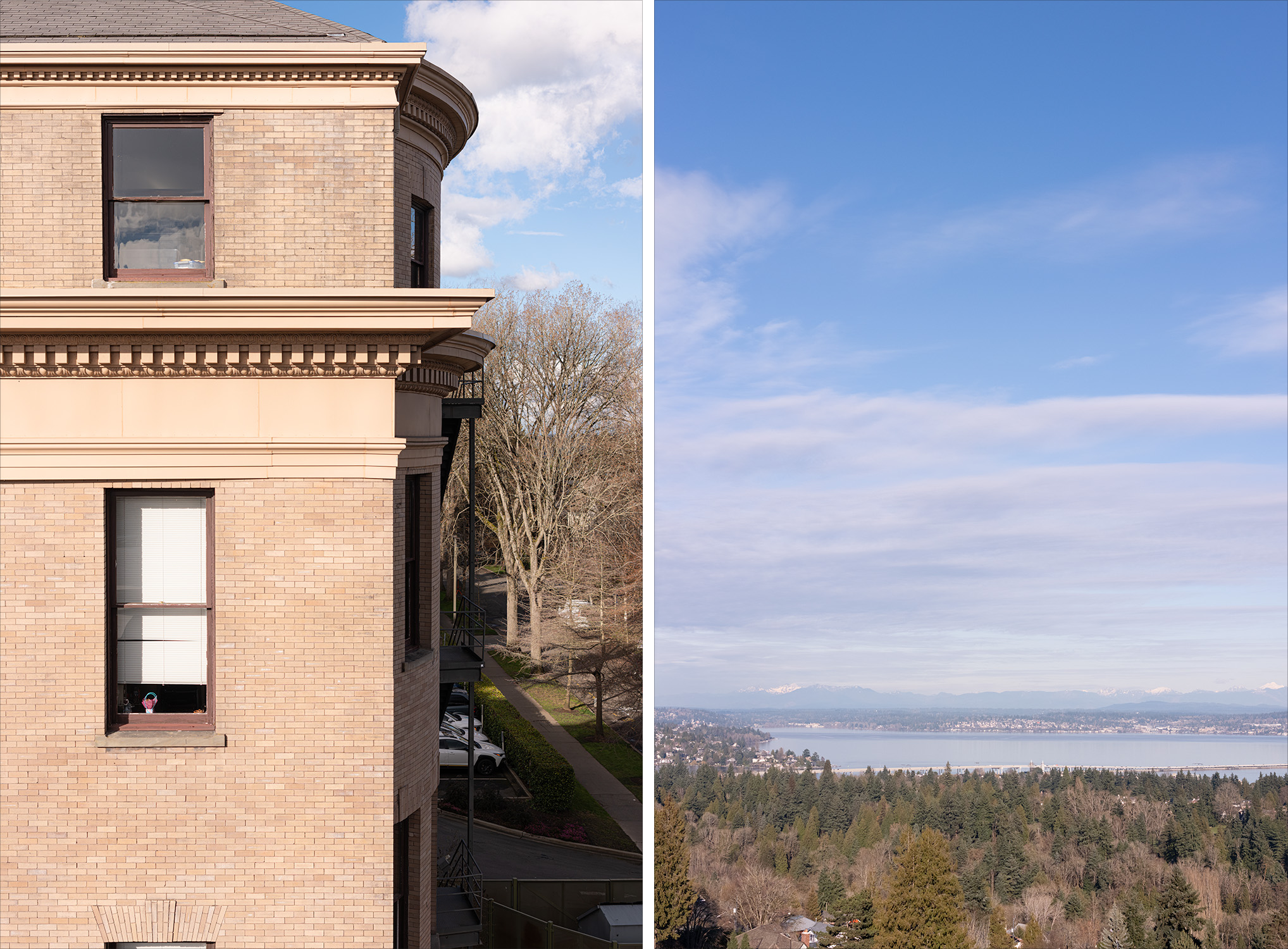
1. The building, an HDR panorama of nine drone images.
2. The background, a drone panorama of three images.
3. The bottle.
4. The shoe.
5. Sarah’s body (Sarah’s my model, but you figured that out yourself).
6. Sarah’s face.
7. Sarah’s right foot.
8. Sarah’s left foot.
9. Sarah’s beautifully flowing hair, a blend of two images.
10. Sarah’s left arm (starting at the elbow), holding the glass atilt.
11. The wine splash.

Goodness, you might say, the Sarah in the final photo is made up of eight exposures? That seems like a lot. Couldn’t you have gotten her all in one shot, with the body position and hair and wine splash and facial expression and everything? Theoretically, I suppose. But in practice, of course not—getting everything you want in a single image is kinda like setting those monkeys down at their typewriters to try and come up with Shakespeare. No, I’m not comparing this photo to The Merchant of Venice. I’m just saying you’d be at it a long, long, long time, and you’re far better off just building a Frankensarah.

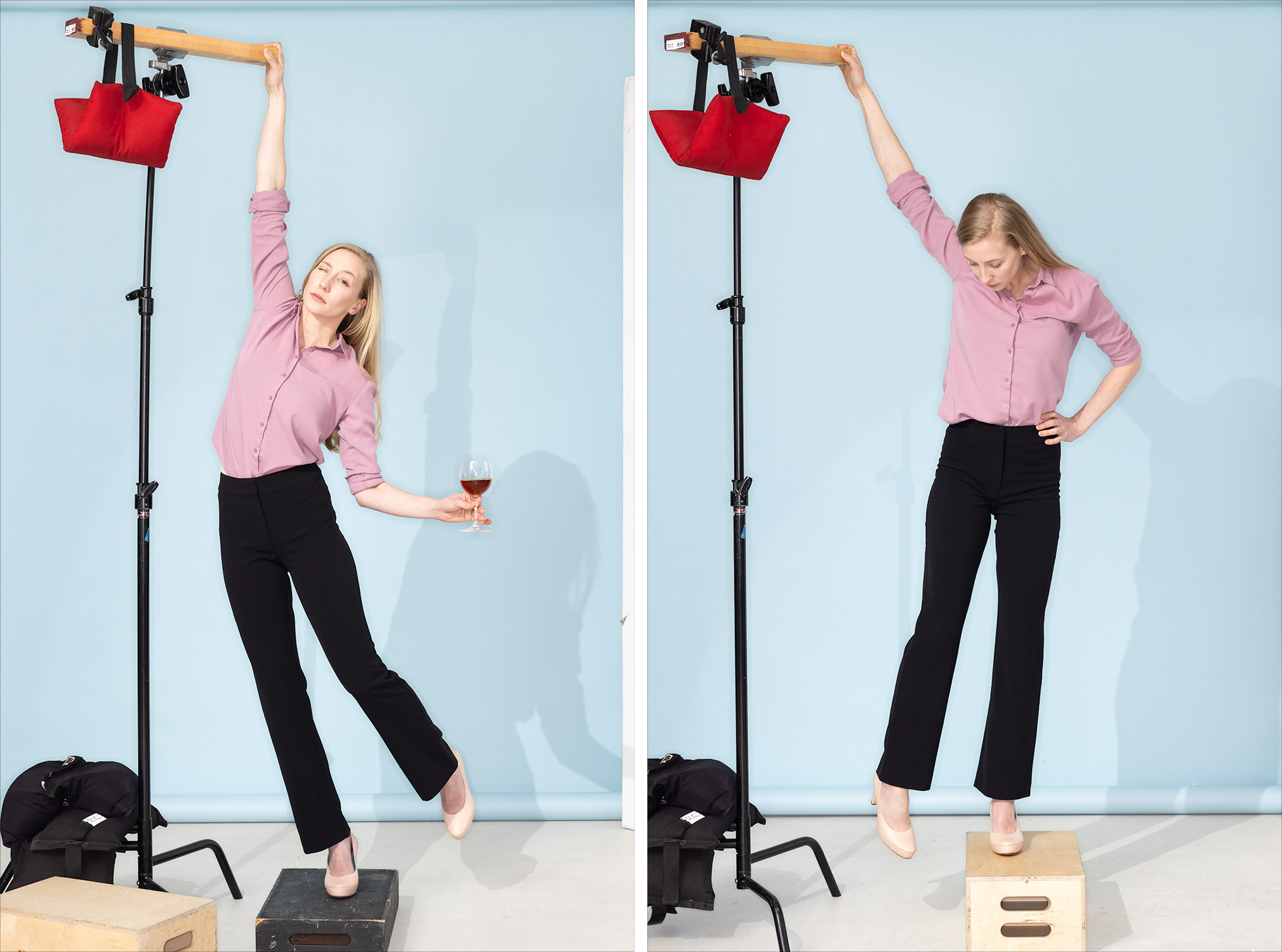
This was the studio setup. On the left, how I positioned Sarah for the shoot (although this wasn’t a frame I used) and on the right, the capture I used for her right foot. You can see why the foot composite was necessary. You can’t photograph her actually hanging by one arm for all kinds of practical reasons, and there’s no way for her to stand in heels that’ll make her foot look as though she’s not standing on something. So, we got her body positioned well and shot her feet and the empty shoe separately.

For Sarah’s flowing mane, I shot about a half dozen pictures of her whipping her hair off to the side. I used two of them to make her hair in the final picture.

You’ve probably already noticed that the pants were black to start with. Sarah didn’t have red pants in her wardrobe (well, she did but they were wrong for it), but I liked the shape of these so we went with them. I changed the color in Photoshop to complement the rest of the image. Black would’ve been too heavy.

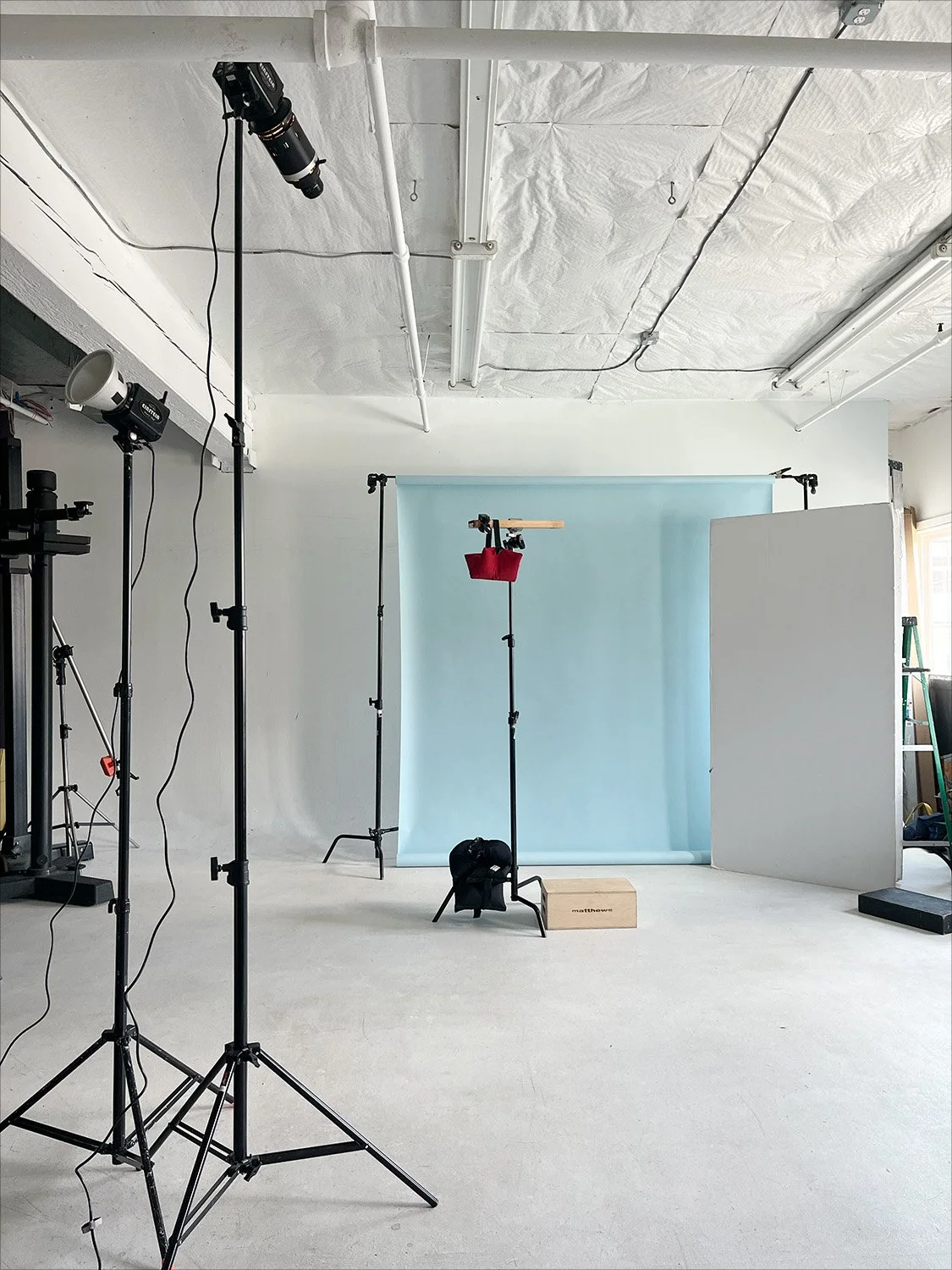
And here’s the studio lighting setup. It’s pretty simple, just three lights.
The one at the far left is bouncing light for a soft but directional fill.
Next to it, on the taller stand, is the main light. It’s a very directional light to mimic the sun in the photo of the building. The long, cylindrical attachment mounted on the front of this light is called an optical snoot. Inside it are lenses that focus the light from the strobe, lining it all up and aiming it in the same direction much like an overhead projector does. The result is a very hard light and sharp-edged shadows, like sunlight on a clear day. It’s a look you can’t otherwise get with a strobe.
The third light, not pictured, was a ring light on my camera for a smidge of front fill.
And at Sarah’s eight o’clock was a large piece of white foam core to bounce a little light in from the back.

In this post I’m coming to the background last, but when making composite images, you finalize the environment first. The background is the foundation of the picture—its tomato base, if you will. You put the subject into the background; you don’t put the background behind the subject. I find it’s good to shoot backgrounds on a tripod so that I can step into frame as a stand-in for my model(s). It helps to make composition decisions, but it also provides a useful reference for how to approach lighting a model in the studio. I couldn’t get into this photo, of course, so I had to think a little harder about the space Sarah would occupy and the proper placement for the drone.

I also had to think about how I wanted Sarah to be lit, because when you’re shooting backgrounds, you have to think about how the light in the scene will work for your subject. I chose late afternoon for the building shot because I wanted the sun coming from camera left at about forty-five degrees. I knew that would look nice on Sarah, if there was also plenty of fill on her. There wasn’t any fill light on the building, of course—the shadows were pretty deep—so I had to shoot it in such a way that I could make it look like there was light filling in those shadows.
That’s partly why there are so many pictures that make up the photo of the building. As I mentioned before, the building is nine photos stitched together. That’s three pictures, top to bottom, and a bracket of three shots for each picture. With that exposure bracket, I could lift those dark shadows as much as I needed to make the lighting of the building and the lighting on Sarah match.
So why not just shoot the building in a single bracketed picture? Why nine pictures, instead of just three? That certainly would’ve been easier, but my done only shoots horizontals. That means I’d’ve had to crop the center out of a horizontal image to get the vertical shot I wanted, and I’d’ve wasted half the frame and ended up with a comparatively lo-res shot of the building. Instead, I shot the bracket of three for the center of the image, tilted the camera up for another bracket, and then down for a third bracket. Stitch those together and you get a beautifully (and unnecessarily) hi-res photo with vast dynamic range.

The building I chose for the picture was Holy Names Academy in Seattle’s Capitol Hill neighborhood. I wanted something that looked more classic than modern, with brick that was light in tone and warm in color, and I needed a fairly deep ledge for my model to hang from so she wouldn’t be too close to the building. Holy Names was perfect.
I did a fair amount of cleanup to the building, mostly straightening and leveling its many lines. I didn’t love the tired look of the brick in the building’s upper section as compared to the lower section, so I copied the lower brick and replaced it.
The sky, water, and trees was the view from a little higher and to the east of Holy Names. This was again a stitch of three photos to get a vertical image, but I didn’t bracket them. I made some contrast and color tweaks, muted the clouds a bit so Sarah would stand out, and removed the houses hiding in the trees. Otherwise, a pretty straight photo.

And…I think that’s it. There it is, a conceptual composite photo.
And look, Ma—no AI!

A Better Headshot

This is a bad headshot…

…and this is a good one.

These photos were taken minutes apart, and I shot the one on the left (as much as it pained me) to illustrate a point. Objectively speaking, it’s a bad picture—the sort you get when it’s time for a new headshot, so your coworker grabs his phone and tells you to stand over there and smile. It’s an awkward experience for both of you, and the result is crude and clumsy and unfit for professional use.

What’s wrong with it, exactly? Geez, where to begin! The light is uneven across the face, but not in a way that’s intentional, interesting, or pleasing, and his eyes are dark and dead. His skin, freshly tanned (burned?) from a trip to Mexico, has a slight “hand me a glass of milk ‘cause I just ate a whole jalapeño” look to it. The background is a bit bright relative to the subject and overly detailed, and both the pose and expression are stiff. Even the composition needs work. In short? It’s a snapshot, not a headshot.

The second picture is the sort of result you can expect from a professional photographer. Most of the fix was done at the time of capture using supplemental lighting on the subject (notice in particular how the catchlights bring the eyes back from the dead), and proper camera settings for a good exposure and blur amount on the background. A little posing direction and easy conversation kept the subject from looking wooden, like the bespectacled telephone pole in the first image. Afterward, in the edit, the red skin tone was adjusted and some other light retouching was done, including global and local adjustments to color, contrast, etc.

If your headshot looks more like the first image than the second, it’s probably time for not just an update, but an upgrade. The way we present ourselves matters, especially in a professional context—a headshot on LinkedIn or your company’s website is often the first look anyone gets at you. Which above version would you rather they see?

If I can help, please send an email my way. Or contact another photographer you may know! Either way, the important thing is to shelve that current headshot if it’s working against you. Good luck out there, and thank you for reading.

BTS: Amanda Knox PR Collateral

Three years ago, I had the good fortune to photograph Amanda Knox for an article in Der Spiegel about her life at the time. You never really know what to expect from a subject when you show up for a shoot, but I wasn’t surprised to find that both Amanda and her husband, Christopher, are incredibly welcoming, engaging, and thoughtful people. And funny! It was a total pleasure getting to know them a little bit over the course of the shoot, and when it was over, I realized I’d’ve been more than happy to keep it going.

Fast forward nearly three years. Out of the blue, I was delighted to hear from them—they needed to update their headshots for their myriad endeavors. What endeavors, you ask? Well, Amanda gives frequent interviews and talks, her new book Free is coming out in March, their Hulu miniseries will be released this year, their podcast Labyrinths is a popular and fascinating listen, and if all that were not enough, they also perform standup comedy. And those are just the things I know about.

Long story short, I got to spend another lovely day at their place with them, their producer Andre, my longtime friend and frequent assistant Josh, and our hair and makeup stylist Lindsey. A huge thank you to all these wonderful people. Here’s a little BTS, courtesy of Josh.

New Year, New You!

Happy new year! Yep, it’s a new year and a new you, and I’ll just go ahead and guess that you could use a new headshot to reflect that fact. That ten-year-old photo you’re using on LinkedIn? Maybe you’ve kept it so long because your hair was perfect that day, or because you were ten pounds lighter back then, or just because being photographed makes you feel like a cat being petted in the wrong direction and you dread the experience. Whatever the reason, let’s be honest. That’s just not you anymore, and you know what that means: it’s no longer a good headshot.

The reason headshots are important is that they’re often the first impression anyone ever gets of us, or our company. You need a good one—current, yes, but also one that reflects who you are. Get in touch, and let’s talk about what you need. Natural or creative and stylized? In studio or on location? Headshots can take any number of forms, and what’s right for you may not be right for someone else. I’m prepared to guide you through the process and get you a brand new picture you’ll love and want to keep for the next ten years. And I promise—you’ll be surprised how easy and downright entertaining a shoot can actually be.

BMW Northwest Life cover shoot

I love editorial photography. The work is creative, the subjects are interesting, and the conditions are unpredictable. You just never know how it’s going to go, so you have to be ready to let go of preconceived notions and roll with the punches. Those punches can come in many forms. Sometimes the punch is that the subject can only give you ten minutes instead of the hour you thought you had. Sometimes it’s a sudden rain shower, or a broken strobe, or a bored security guard. Whatever it is, you have to take it in stride, figure it out, and move forward.

In this case, the punch was a car. The cover of the magazine was to be an environmental portrait of Manfred Scharmach, owner of BMW Northwest, with his gorgeous 1939 BMW 327/28. Full disclosure, I don’t know anything about cars. I can fill the gas tank and change a tire, and I know you don’t want frozen wiper fluid lines on a cross country road trip in the dead of winter, but that’s about it. I do appreciate a beautiful design when I see it though, and this car shook the Dick Tracy loving child in me wide awake.

In our conversations about the cover image, Lori Randall (Randall PR) had in mind a rural setting—trees, sky, maybe even some water somehow. We’d picked several spots near the dealership to scout ahead of time and I checked them out on Google’s street view. On the morning of the shoot, Lori and I and Uly, my assistant, visited a couple locations and picked our favorite: a grassy lot with trees in the background, very Pacific Northwest. By the time we’d be shooting, the sun would be in just the right spot for a late morning rim light. Plans!

So back to the punch: the car wouldn’t start, and there was no way to get it from the storage garage to the location we’d chosen. While Manfred kicked himself for not trying the car the week before, we looked for another option. Lori adjusted to the situation brilliantly, and we all quickly agreed that the wall of the garage was perfect. It didn’t say rural, of course, but its two-tone paint scheme echoed the car’s and once the BMW was pushed halfway along the building to the right spot, the background was beautifully broken up by the shadow of a tree. I knew the sun on Manfred would be a problem and we were ready to break out the scrim to deal with it, but once the strobe with the octabank was in place, it acted as a flag and did the job for us.

We shot away and Manfred did a wonderful job of letting go of his frustration. In the end, Lori and I were both super happy, especially given the circumstances. The results were objectively great and the shot even looks intentional. It wasn’t what any of us had envisioned, but sometimes that’s how it goes. Curveballs! Isn’t photography fun?

BMW Northwest Life magazine with location portrait of Manfred Scharmach on the cover.